By using this site, you agree to the Privacy Policy and Terms of Use.
Accept
Green Print ReportGreen Print ReportGreen Print Report
Font ResizerAa
  • Home
  • News
  • Climate
  • Renewable Energy
  • Biodiversity
  • Contact US
Reading: Greater Horn of Africa in Contrasting Extremes: Flood Risk and Heat Stress Across East Africa
Font ResizerAa
Green Print ReportGreen Print Report
  • Home
  • News
  • Climate
  • Renewable Energy
  • Biodiversity
  • Contact US
Search
  • Home
  • News
  • Climate
  • Renewable Energy
  • Biodiversity
  • Contact US
Have an existing account? Sign In
  • Home
  • News
  • Climate
  • Renewable Energy
  • Biodiversity
  • Contact US
© The Greenprint Report. All Rights Reserved.
greater horn of africa
Weather Forecasts

Greater Horn of Africa in Contrasting Extremes: Flood Risk and Heat Stress Across East Africa

Editorial Desk
Last updated: 2026/04/01 at 11:26 AM
By Editorial Desk 4 Min Read
Share
4 Min Read
SHARE

A shifting weather pattern is expected across the Greater Horn of Africa in the week of March 31 to April 7, 2026, with rainfall intensifying over southern zones while dangerous heat stress builds across northern areas.

According to the IGAD Climate Prediction and Applications Centre (ICPAC), enhanced rainfall will be concentrated over the southern parts of Tanzania, even as rising temperatures push heat stress to near-danger levels across northern South Sudan and south-eastern Sudan.

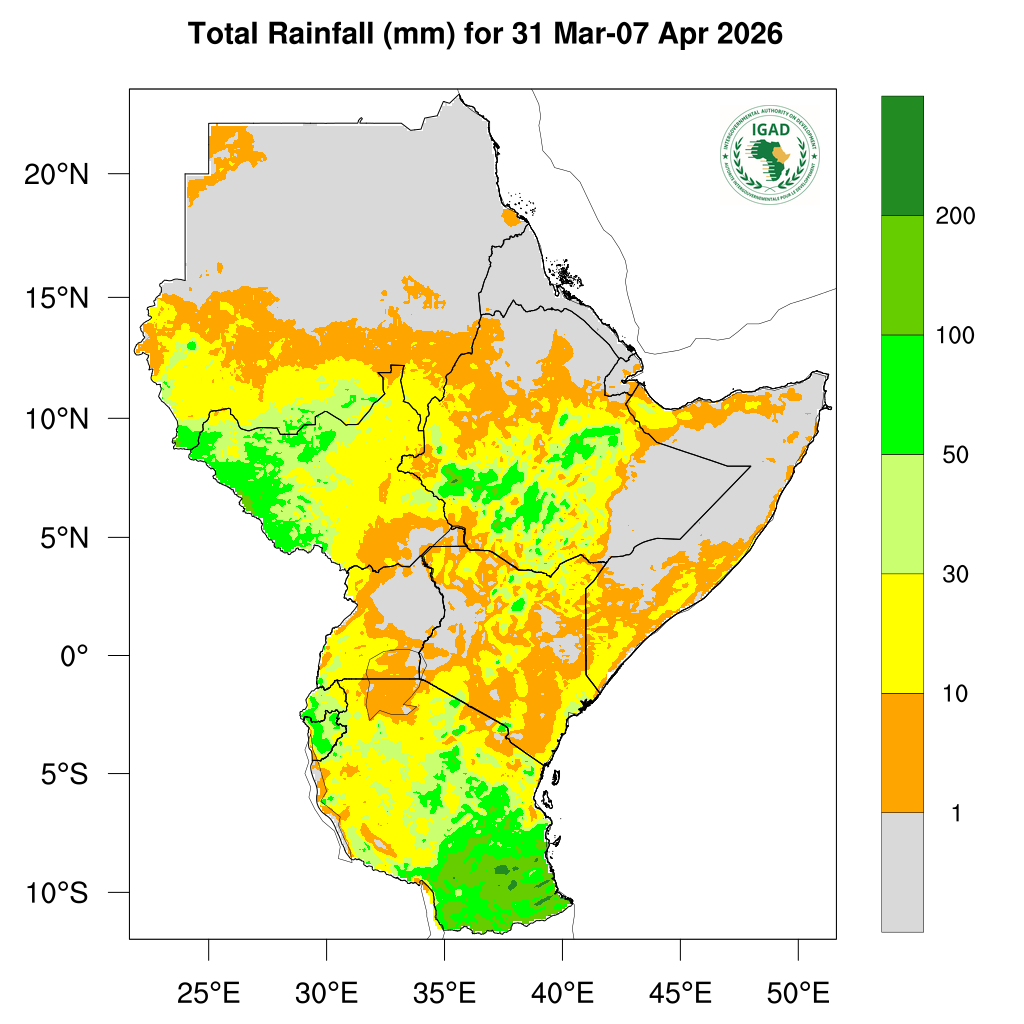
The forecast points to moderate rainfall, ranging between 50 and 200mm, over southern Tanzania, southern Ethiopia, and western regions of South Sudan, Rwanda, and Burundi. These conditions signal a strengthening of rainfall systems in the southern sector of the region, while rainfall remains limited elsewhere in the region.

Elsewhere, much of Kenya, central to northern Tanzania, and large parts of South Sudan are expected to receive light rainfall of less than 50mm.
greater horn of africa

Similar conditions are projected across southern and northern Somalia, parts of Sudan, and western Uganda, highlighting a continued uneven distribution of rainfall.

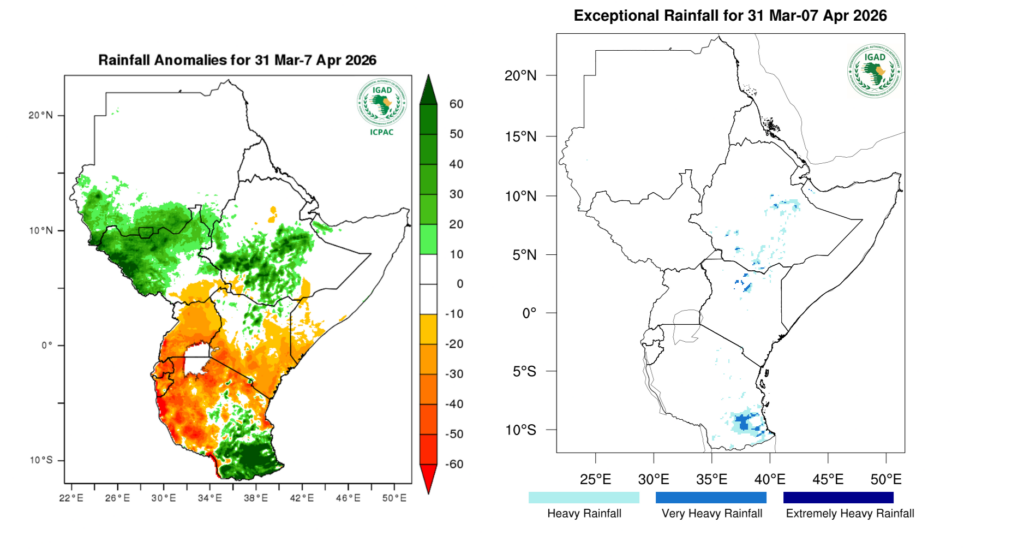
Rainfall anomalies further reinforce this divide for the Greater Horn of Africa, with Wetter-than-usual conditions likely over southern Tanzania, central to southern Ethiopia, and across western to northern South Sudan, extending into southern Sudan.

In contrast, drier-than-usual conditions are expected across most parts of Uganda, Rwanda, Burundi, western and northern Tanzania, and southern and eastern Kenya.

Notably, some areas could see extreme rainfall. “Rainfall exceeding the 90th percentile is expected over parts of southern Tanzania and isolated areas in central to southern Ethiopia,” ICPAC notes, raising the likelihood of localized extremes.
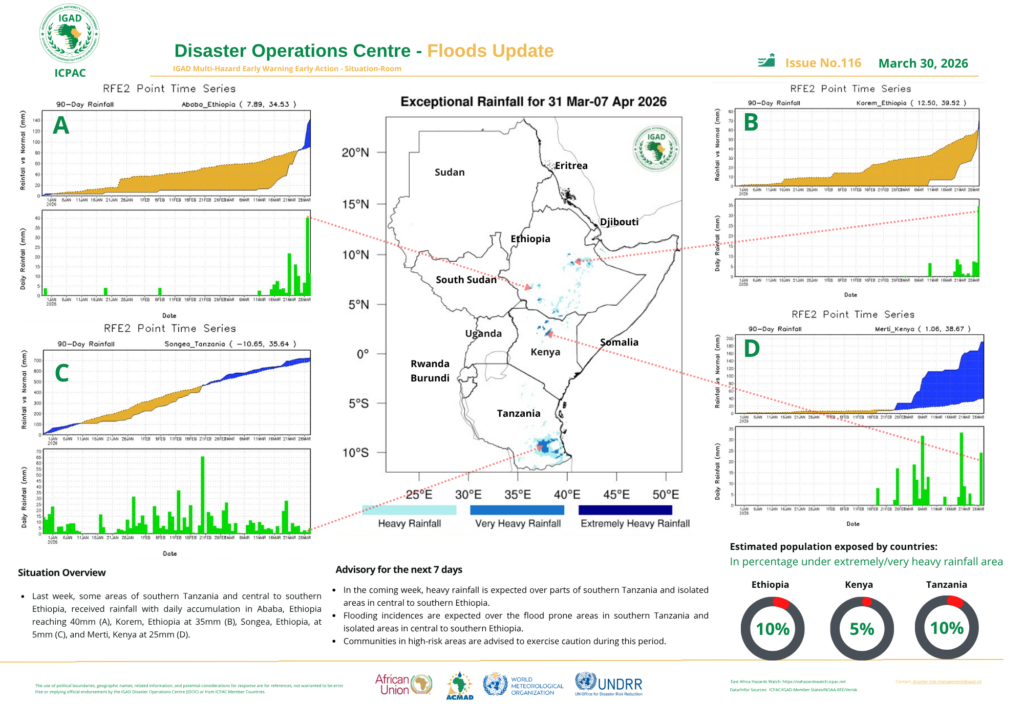
This increases the risk of flooding, particularly in southern Tanzania and parts of central to southern Ethiopia. Communities in flood-prone zones are being urged to remain cautious as water levels could rise quickly during the week.

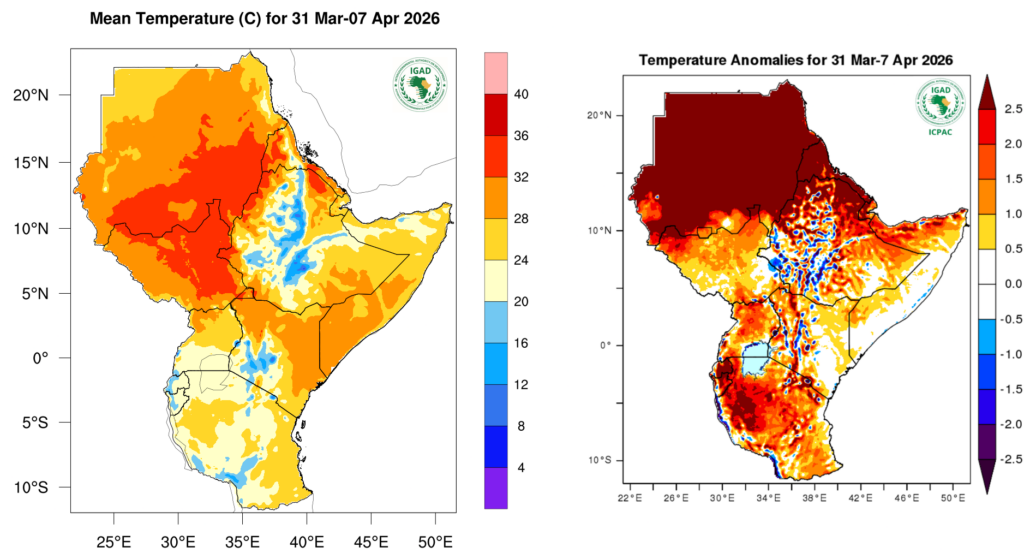
At the same time, temperatures are expected to climb across much of the greater horn of Africa. Daytime temperatures exceeding 32°C are forecast over central to eastern South Sudan and south-eastern Sudan, while most of the Greater Horn will experience moderate to high temperatures ranging between 20°C and 32°C.

Cooler conditions, below 20°C, are likely to persist in highland areas, including parts of the Ethiopian highlands, central to western Kenya, western Rwanda and Burundi, as well as sections of south-western Tanzania.
greater horn of africa

Despite these cooler areas, the broader trend points to warmer-than-usual conditions across most of the region, with only highland areas expected to experience relatively cooler anomalies.

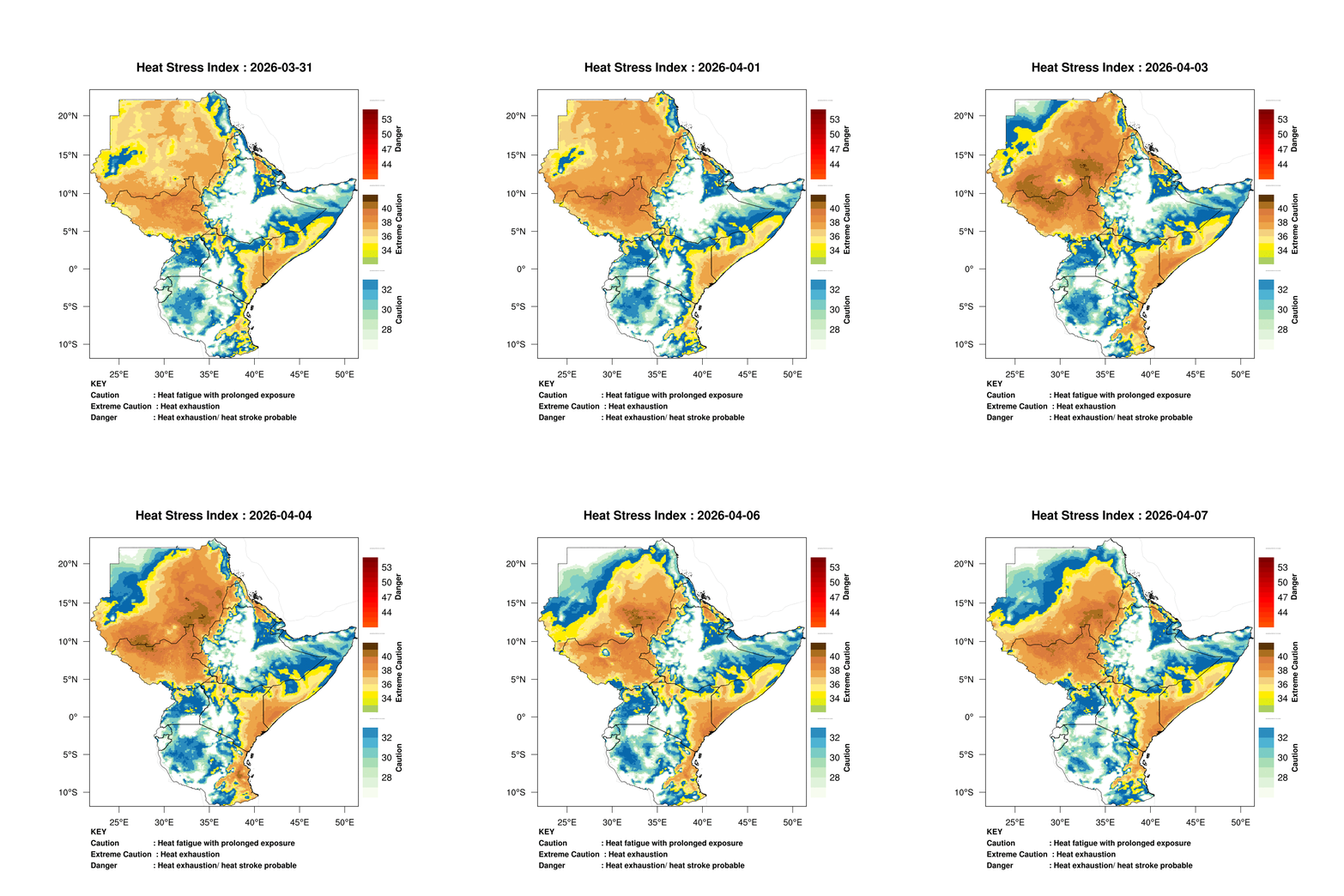
Heat stress remains a growing concern, with ICPAC warning that conditions could reach the ‘danger’ category over northern South Sudan and south-eastern Sudan.

This is to be witnessed in additional hotspots emerging across eastern Tanzania, eastern Kenya, and south-western Somalia.
greater horn of africa

The convergence of intense rainfall in some areas and dangerous heat in others reflects the complex and often contrasting climate signals shaping the Greater Horn of Africa this season.

As the region navigates these extremes, ICPAC continues to emphasize the importance of localized forecasts and preparedness measures, particularly for communities exposed to floods and heat-related risks.

Recent flood events across the region, including in Nairobi, have already highlighted the human and infrastructural toll of extreme weather, underscoring the urgency of preparedness as these conditions persist.

You Might Also Like

Kenya Met warns of Heavy Rainfall and Possible Flooding in April

Enhanced Rainfall Expected Across Greater Horn of Africa as Flood as Heat Risks Persist

Heavy Rains to Intensify Across East Africa as Flood Risks Rise

Kenya Strengthens Climate Forecasting with Creation of Kenya Meteorological Service Authority

Greater Horn of Africa Set for Moderate Rains While Heat Stress Intensifies in South Sudan

Editorial Desk April 1, 2026 April 1, 2026
Share This Article
Facebook Twitter Email Copy Link Print
Leave a comment

Leave a Reply Cancel reply

Your email address will not be published. Required fields are marked *

Weekly Newsletter

Subscribe to our newsletter to get our newest articles instantly!


Also Read

Sports

SportPesa League to crown season’s best at inaugural Gala Awards

The 2025/26 SportPesa League season reaches its climax this Thursday with the…

By Editorial Desk 5 Min Read
CorporateNews

fly748.com Eyes Cooperative Sector Partnerships to Expand Domestic Travel Market

fly748.com is pursuing strategic partnerships with Kenya’s cooperative societies as it seeks…

By Editorial Desk 4 Min Read
News

Bomet Teacher Bags Kshs 18.6 Million as SportPesa Rewards Jackpot Winners

SportPesa has celebrated three jackpot winners during an unveiling event held in…

By Editorial Desk 3 Min Read

More Popular from GreenPrint Report

UNEA-6
ClimateSustainability

UNEA-6 Sparks Global Collaboration for a Sustainable Future

By Editorial Desk 4 Min Read
UNEA-6

UNEA-6 Sparks Global Collaboration for a Sustainable Future

By Editorial Desk
new collectoive quantified goal
ClimateSustainability

New Collective Quantified Goal as a Future Financing Solution

By Editorial Desk 4 Min Read
- Advertisement -
Ad image
ClimateSustainability

Enhancing Disaster Preparedness, Resilience in Madagascar

Cheneso marked the onset of the seasonal tropical cyclones disaster in Madagascar in January 2023, being…

By Editorial Desk
ClimateSustainability

Desert Locust a Probable Threat in IGAD Region

The 65th Greater Horn of Africa Climate Outlook Forum (GHACOF), which took place over two days…

By Editorial Desk
ClimateSustainability

Desert Locust a Probable Threat in IGAD Region

The 65th Greater Horn of Africa Climate Outlook Forum (GHACOF), which took place over two days…

By Editorial Desk
ClimateSustainability

Climate and Clean Air Initiatives Advances in the CCAC Ministerial Meeting

Climate and Clean air initiatives are vital to enhance regional coordination, foster private sector engagement and…

By Editorial Desk
ClimateSustainability

President Ruto Emphasizes Need for Action on Climate Crisis at Hand

President Ruto is on frontline championing Climate action rather than more climate talks when the situation…

By Editorial Desk
Green Print Report

The Greenprint Report is an independent, Kenya-focused online news platform that reports on sustainability and development issues. The goal is to inform, inspire, and engage readers with credible stories covering environmental conservation, climate change, and green innovation.

Contact:
Editorial Team: editor@greenprintreport.co.ke
Cell: +254 725 358401

Editorial Team: editor@greenprintreport.co.ke

Categories

  • Home
  • News
  • Climate
  • Renewable Energy
  • Biodiversity
  • Contact US

Quick Links

  • My Bookmarks
  • Customize Interests

The Greenprint Report © 2025. All Rights Reserved. Powered by Afritech Media

Welcome Back!

Sign in to your account

Lost your password?