
FedEx and the Kenya Association of Manufacturers have urged closer collaboration between industry and policymakers to strengthen logistics systems as a key driver of Kenya’s manufacturing growth and export competitiveness.
The call emerged during a high-level CEOs’ breakfast that convened business leaders, government representatives, and logistics experts to assess how time-definite transport solutions can support Kenya’s industrial ambitions. The country is targeting an increase in manufacturing’s share of GDP from 7.3 percent to 20 percent by 2030, according to the Kenya National Bureau of Statistics.
As global supply chains undergo rapid shifts and logistics costs remain volatile, stakeholders stressed that efficient, predictable, and integrated transport networks will be critical for Kenya to compete in regional and international markets.
Discussions centered on unlocking growth in high-value, time-sensitive industries such as pharmaceuticals, automotive, electronics, and agribusiness—sectors that depend heavily on speed and reliability in delivery.
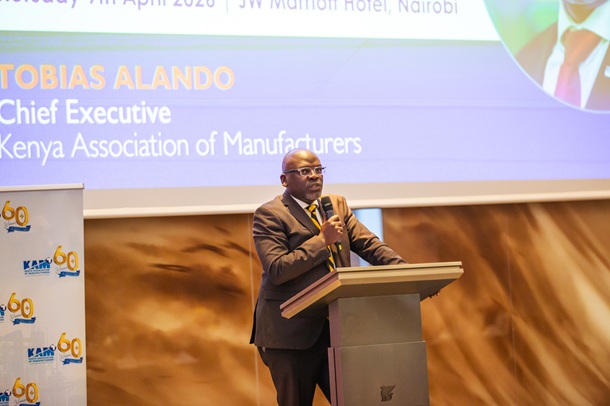
KAM Chief Executive Tobias Alando highlighted the growing pressure on manufacturers from global geopolitical tensions, noting that these disruptions are driving up trade costs and destabilizing traditional supply routes.
“Beyond global developments, structural issues within the logistics ecosystem, including regulatory requirements and infrastructure capacity, continue to shape the competitiveness of Kenyan products,” he said.
FedEx’s Managing Director of Sales for Sub-Saharan Africa, Leon Bruwer, described Kenya as a strategic hub in the company’s African network, pointing to continued investment in air cargo capacity and global connectivity through Nairobi.
“Our global air network allows Kenyan businesses to access international markets with greater speed and certainty, which is essential in today’s competitive trade environment,” Bruwer said.
Kenya’s success in exporting perishable goods such as tea and flowers was cited as proof of the importance of efficient logistics. However, stakeholders noted that moving into more advanced manufacturing will require even greater precision in supply chains to protect product quality and meet strict delivery timelines.
Participants also raised concerns about the limited accessibility of air freight for small and medium-sized enterprises, calling for reforms and innovations to make logistics services more affordable and inclusive across African markets.
FedEx outlined ongoing initiatives to streamline customs processes and deploy digital solutions aimed at simplifying cross-border trade, particularly for SMEs seeking to expand internationally.
The meeting concluded with a renewed commitment from both FedEx and KAM to work together in enhancing Kenya’s logistics ecosystem, improving global market access, and supporting the country’s transition toward a more competitive manufacturing sector.