By using this site, you agree to the Privacy Policy and Terms of Use.
Accept
Green Print ReportGreen Print ReportGreen Print Report
Font ResizerAa
  • Home
  • News
  • Climate
  • Renewable Energy
  • Biodiversity
  • Contact US
Reading: A Disaster Foretold: Why Nairobi Was Not Ready for the Floods
Font ResizerAa
Green Print ReportGreen Print Report
  • Home
  • News
  • Climate
  • Renewable Energy
  • Biodiversity
  • Contact US
Search
  • Home
  • News
  • Climate
  • Renewable Energy
  • Biodiversity
  • Contact US
Have an existing account? Sign In
  • Home
  • News
  • Climate
  • Renewable Energy
  • Biodiversity
  • Contact US
© The Greenprint Report. All Rights Reserved.
Cities

A Disaster Foretold: Why Nairobi Was Not Ready for the Floods

Sammy Mwangi
Last updated: 2026/03/12 at 2:44 PM
By Sammy Mwangi 5 Min Read
Share
5 Min Read
SHARE

Earlier this month, in an advisory on 3rd March, the Kenya Meteorological Department warned of heavy rainfall with the risk of flooding across the country. Due to the early warning, a functional authority would be expected to create contingencies and prepare for the impending disaster.

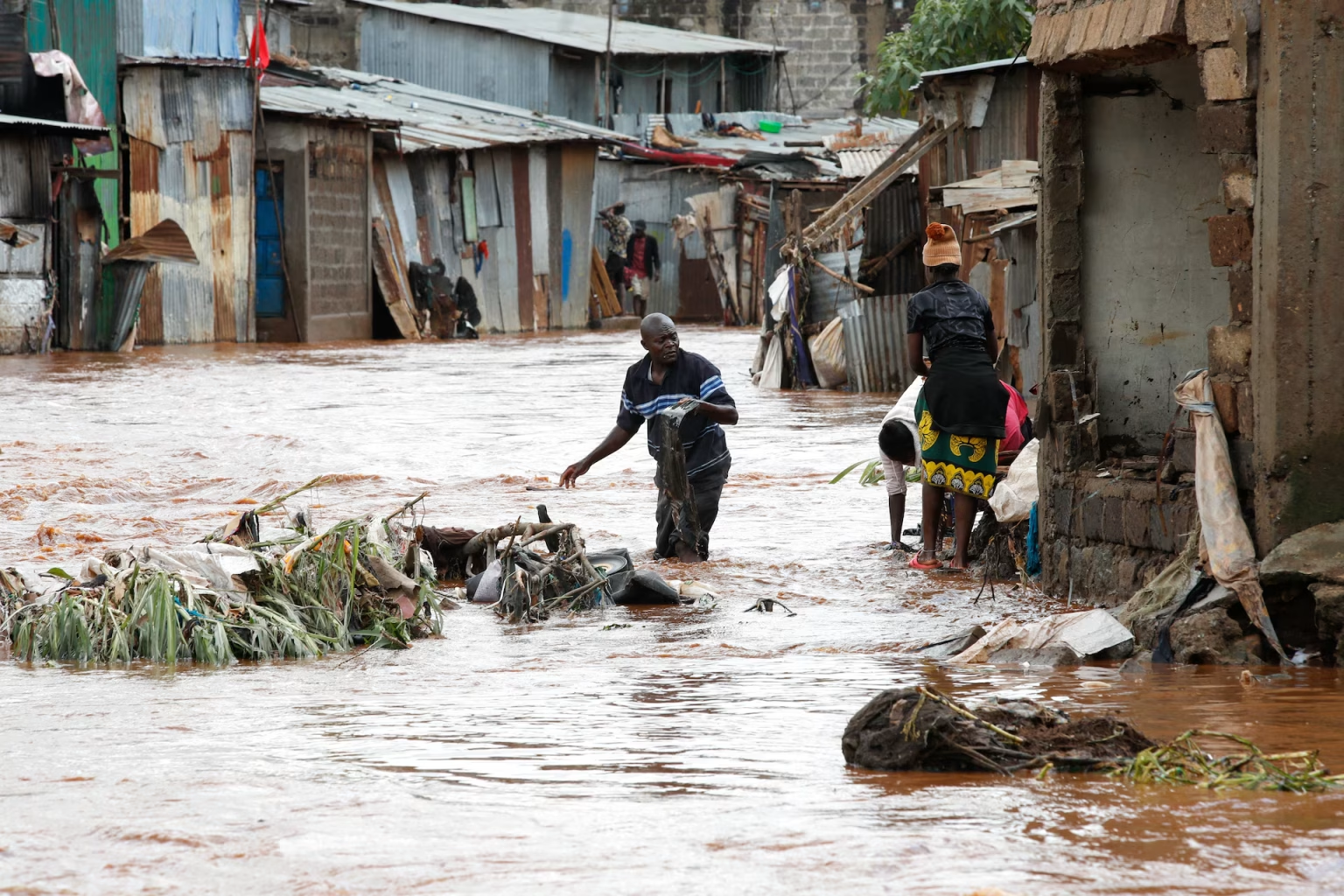
However, more than 40 people tragically lost their lives from the floods that rocked Nairobi and various parts of Kenya since the 6th. According to the statement by the Civil Society Organizations, fatalities are from the capital, Nairobi, alone, and scores of people are still unaccounted for. 50,000 others have been displaced after floodwaters either destroyed or submerged their homes.

The Resilience Action Network Africa (RANA) expressed concern, highlighting that the floods reveal long-standing failures and system flaws in urban planning, drainage infrastructure, and emergency preparedness that have left communities dangerously exposed to predictable impacts of the changing climate.

According to Aggrey Aluso, Executive Director of RANA, while the unfortunate flooding witnessed in Nairobi and other parts of Kenya on Friday evening is the reality of African communities that are on the frontline of the impacts of climate change, it is the systemic failure of the government that has led to the needless loss of life, livelihoods, and property.

Flooding witnessed in Nairobi and other parts of Kenya on Friday evening is the reality of African communities that are on the frontline of the impacts of climate change

“With the availability of scientific predictive models, governments should be able to anticipate and prepare for such eventualities,” he said.

He emphasized that failure to prepare for these eventualities shifts the burden of responsibility to the most vulnerable who have the least ability to respond effectively, further undermining their resilience capacity.

While there have been efforts to expand the existing drainage system, this has largely been outpaced by the rapidly growing population in the sprawling metropolis, with most parts of the city being either underserved by the drainage system or being without any at all.

Moreover, Nairobi is notorious for the encroachment of riverine areas, with some neighborhoods built entirely on riparian land. These become flood flashpoints during the rainy season.

Nairobi is notorious for the encroachment of riverine areas, with some neighborhoods built entirely on riparian land.

Statistics show that 70 percent of the city’s residents occupy just 5 percent of its land. According to RANA, the rule of planners, lawyers, and architects has too often produced exclusion rather than safety.

Today, roughly half of Nairobi’s informal settlements sit on private land that was once public, 40 percent on riparian reserves, and only 10 percent on uncontested public land.

Patrick Ochieng, Executive Director, Ujamaa Centre, highlighted that Weak oversight in the physical planning process allows unsafe developments to expand while critical infrastructure, such as solid waste management, remains inadequate.

To emphasize the disparity, Dan Owala, National Coordinator, People’s Health Movement Kenya, said that when governments fail to build anticipatory and disaster preparedness systems, these disasters will become more frequent, and the damage more widespread.

“The loss of life and destruction of property following recent floods exposed long-standing flaws in urban planning, drainage infrastructure, and emergency preparedness,” he said.

Moreover, Easter Achieng, Executive Director of the Kenya Female Advisory Organisation, highlighted that extreme weather is intensifying across Africa, placing rapidly growing cities like Nairobi on a tightrope.

“We must come to a sober realization that the drainage systems and infrastructure built for past rainfall patterns can no longer cope with the intensity and frequency of weather patterns we are seeing now,” she said, adding that strengthening urban resilience and effective early warning systems must be treated as a matter of urgency.

Flood disasters are rarely acts of nature alone. They are a reflection of choices and decisions on land use, infrastructure access, and whose safety receives priority.

Consequently, extreme weather combined with rapid urbanization will continue to test urban systems. Communities that have contributed the least to global climate change face the greatest exposure to its consequences.

Therefore, urgent reforms are needed to safeguard communities that have been dangerously exposed to the predictable impacts of the changing climate.

Read Also: Is Unplanned Urbanization Increasing the Dangers of Floods in Cities

You Might Also Like

EU Shows How Cities Can Turn Climate Pledges into Action

Heavy Rains to Intensify Across East Africa as Flood Risks Rise

Clean Air Action Takes Center Stage at Better Air Quality Conference 2026

Mai Mahiu Tragedy: Devastation Unleashed by Floods

Ravaging Floods: A Call for Proactive Response and Coordination

TAGGED: Floods
Sammy Mwangi March 12, 2026 March 12, 2026
Share This Article
Facebook Twitter Email Copy Link Print
Leave a comment

Leave a Reply Cancel reply

Your email address will not be published. Required fields are marked *

Weekly Newsletter

Subscribe to our newsletter to get our newest articles instantly!


Also Read

GovernanceNews

Nature loss is now a boardroom issue, African company directors told

Company boards across Africa are being urged to put nature-related risks at…

By Editorial Desk 6 Min Read
AviationBusiness

Turkish Airlines Taps Çelebi Aviation as Nairobi Cements Its Role as an East African Aviation Hub

Nairobi's Jomo Kenyatta International Airport (JKIA) is adding another major carrier to…

By Editorial Desk 3 Min Read
Sports

Sevens Rugby’s Best Weekend Yet: Inside a Wild Two Days in Kisumu

There's a version of this story where KCB simply win. They arrived…

By Editorial Desk 5 Min Read

More Popular from GreenPrint Report

UNEA-6
ClimateSustainability

UNEA-6 Sparks Global Collaboration for a Sustainable Future

By Editorial Desk 4 Min Read
UNEA-6

UNEA-6 Sparks Global Collaboration for a Sustainable Future

By Editorial Desk
new collectoive quantified goal
ClimateSustainability

New Collective Quantified Goal as a Future Financing Solution

By Editorial Desk 4 Min Read
- Advertisement -
Ad image
ClimateSustainability

Enhancing Disaster Preparedness, Resilience in Madagascar

Cheneso marked the onset of the seasonal tropical cyclones disaster in Madagascar in January 2023, being…

By Editorial Desk
ClimateSustainability

Desert Locust a Probable Threat in IGAD Region

The 65th Greater Horn of Africa Climate Outlook Forum (GHACOF), which took place over two days…

By Editorial Desk
ClimateSustainability

Desert Locust a Probable Threat in IGAD Region

The 65th Greater Horn of Africa Climate Outlook Forum (GHACOF), which took place over two days…

By Editorial Desk
ClimateSustainability

Climate and Clean Air Initiatives Advances in the CCAC Ministerial Meeting

Climate and Clean air initiatives are vital to enhance regional coordination, foster private sector engagement and…

By Editorial Desk
ClimateSustainability

President Ruto Emphasizes Need for Action on Climate Crisis at Hand

President Ruto is on frontline championing Climate action rather than more climate talks when the situation…

By Editorial Desk
Green Print Report

The Greenprint Report is an independent, Kenya-focused online news platform that reports on sustainability and development issues. The goal is to inform, inspire, and engage readers with credible stories covering environmental conservation, climate change, and green innovation.

Contact:
Editorial Team: editor@greenprintreport.co.ke
Cell: +254 725 358401

Editorial Team: editor@greenprintreport.co.ke

Categories

  • Home
  • News
  • Climate
  • Renewable Energy
  • Biodiversity
  • Contact US

Quick Links

  • My Bookmarks
  • Customize Interests

The Greenprint Report © 2025. All Rights Reserved. Powered by Afritech Media

Welcome Back!

Sign in to your account

Lost your password?