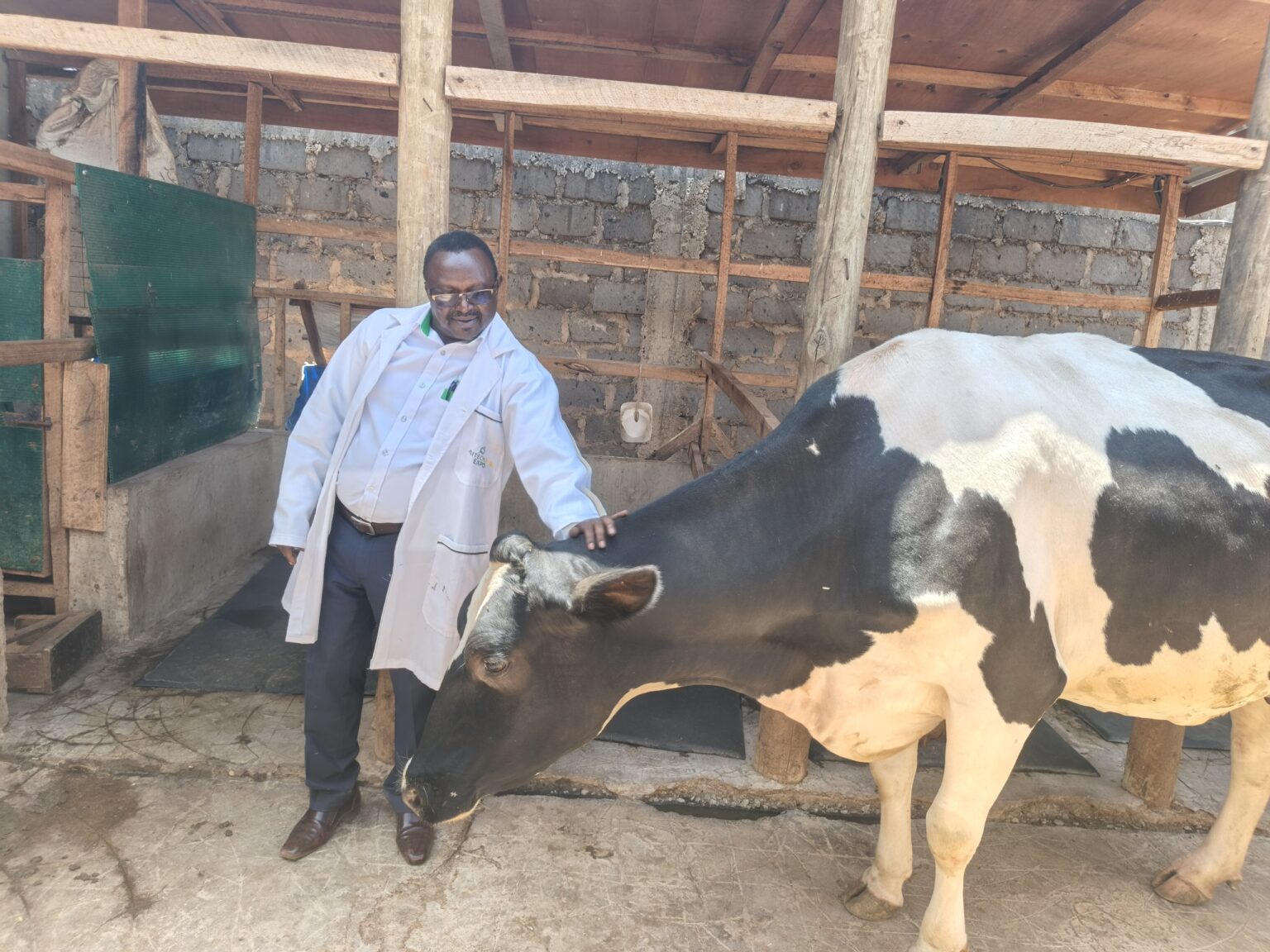

“Before we became Mazao na Afya Ltd, we were Farmers Price Centre Limited,” began the CEO, Dr. Peter Karanja Ndungu, when we sat down with him to understand the organization’s 30-year journey.
As an agricultural extension officer stationed in Mwea Region, the doctor was in a prime position to identify the gaps in input supplies and in knowledge, besides the associated issues in agriculture.
Founded in 1996 with 180,000 seed capital, Mazao na Afya’s core objective is to provide solutions, from input to advice.
The 360° Farmer Support Model
“The farmer is very close to my heart,” says Dr. Karanja, adding that, “we are not an input supplier, we are a solution provider.”
Under the leadership of the CEO, Mazao Na Afya has expanded beyond retail into a fully integrated group model designed to close persistent gaps in the agricultural value chain.
Today, Mazao Na Afya Ltd anchors distribution across North Kenya and other regions, while AgriPrice Centre Ltd, established in 2016, addresses importation and crop nutrition gaps.

In 2022, the company launched Agitec Seedlings, professionalizing seedling propagation, and complemented this with the Mazao Na Afya Circle, a financial support structure for farmers and stockists.
“Farmers were travelling all the way to Naivasha for seedlings. We needed to bring that service closer to them,” he highlights
He adds that technology has changed, and farmers can no longer rely on traditional nurseries behind the house
Consequently, capacity building has become institutionalized through the annual Agitech Grad Expo, while digital transformation is underway via the M-Toroli App, an online selling platform that connects farmers to inputs more efficiently.
“Efficiency demanded expansion, and this new facility is a significant milestone for the Mazao Group.”
This reflects the company’s strategic response to the evolving needs of Kenya’s farming community. As it marks three decades of operation, Mazao Na Afya is positioning itself less as a shop and more as an agricultural institution.
To realize this, the group operates around a 360-degree farmer support model.
“We want to support the farmer from seed to market.”
This is done by providing soil testing and advisory services, including soil analysis, precision nutrient application through agronomy teams dispatched to farms.
Besides propagation, Mazao na Afya also does production support, supervised planting and follow-up, ensuring support continues until harvest.
The only challenge remaining now is the market, and we are looking for the value addition to solve it,” he highlights.

Climate Change & Adaptation Strategy
Dr. Karanja says that over-reliance on rainfed agriculture is no longer tenable, pointing out that rains failed last year, leading to losses.
Besides soil testing and advice on irrigation systems, the organization, through its partners are encouraging farmers to adopt drone spraying, “as it is efficient, effective, and protects the farmer from chemical exposure.
“We need to secure the farmers’ investment,” says Dr. Karanja.
Moreover, the group’s financial innovations have significantly changed the adaptation landscape, by using stockists as the last-mile delivery in a system that is 70% distribution and 30% retail model.
With their ecosystem banking model, the banks can use Mazao na Afya’s transaction data to set credit limits. Additionally, to eliminate any risk of misappropriation, the funds flow directly from the Bank to Mazao, further solving delayed payment issues.
He adds that the country is not food secure, saying that we cannot continue farming on a subsistence level.
“Farming must become agribusiness; we cannot continue importing maize while we have land here,” he says.
He emphasizes that the government must be deliberate about constructing dams, and value addition and processing must happen near production zones.
Innovation and the Future
According to Dr. Karanja, innovation must be at the centre of each business, and digital integration is central to the company’s long-term strategy.
The M-Toroli app, designed to allow farmers to order inputs remotely and receive delivery directly to their farms, embeds agronomist consultation into the purchasing process, merging advisory and commerce in one platform.
Internally, the company is exploring robotics and automation to enhance inventory efficiency, reduce waste, and improve traceability.
In a sector where climate uncertainty and input inefficiencies persist, innovation is no longer optional; it is structural.
“Technology has exponential returns when it is well employed,” he adds.
Read Also: Mary Nga’ng’a’s Organic Farming Journey