
At the intraregional level, the region’s performance was driven by the Democratic Republic of Congo, which grew by 8.5 percent increasing the stance of Central Africa economically.
Central Africa achieved real GDP growth of 5.0 percent in 2022, compared with 3.4 percent in 2021. The rebound in economic activity was driven by favorable prices for raw materials, in a region that is home to net exporters of crude oil, minerals, and other commodities. The region’s growth rate was higher than the African average, which is estimated at 3.8 percent in 2022, down from 4.8 percent in 2021. It is set to settle at 4.9 percent in 2023 and 4.6 percent in 2024.
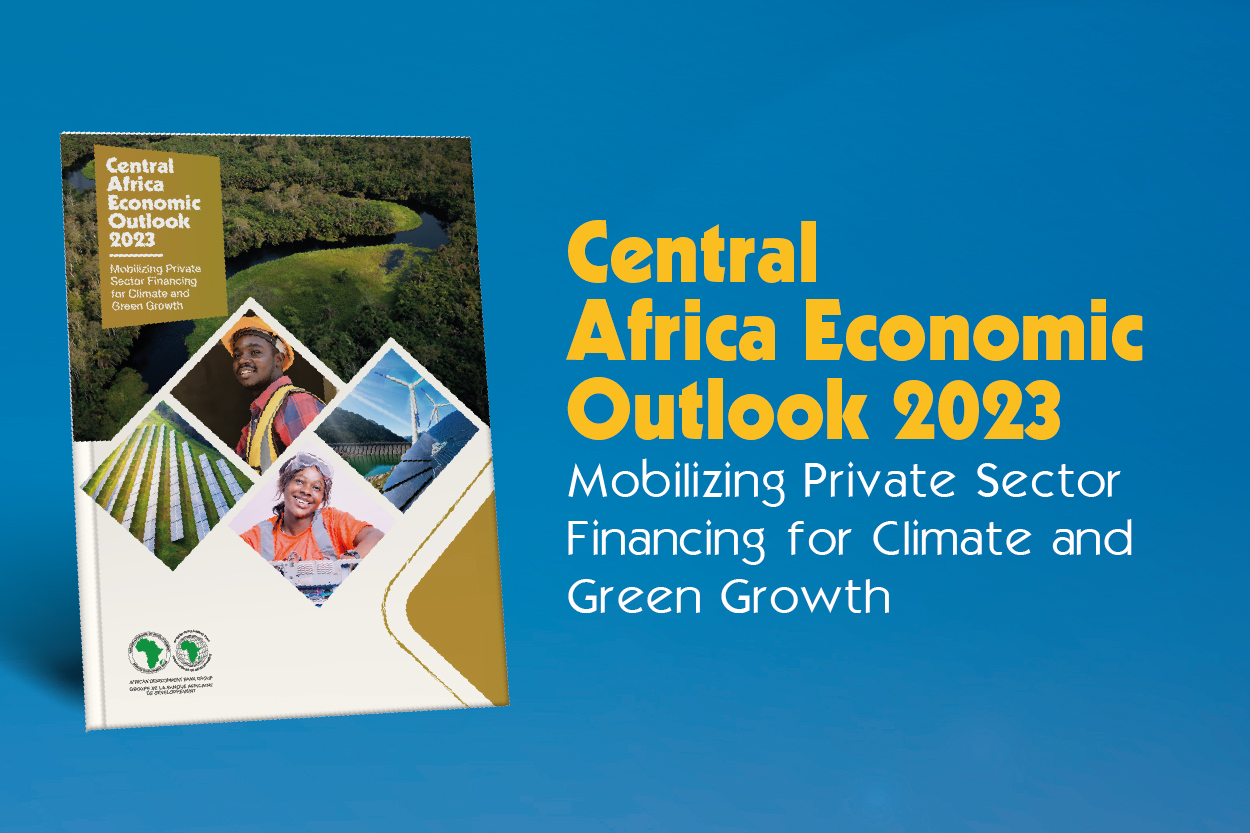
These are some of the findings of the Central African Economic Outlook 2023 report (https://apo-opa.info/3OiQ1UB), published on 31 July by the African Development Bank. The report has the theme “Mobilizing Private-Sector Financing for Climate and Green Growth in Africa”. Produced annually by the African Development Bank, the report offers an assessment of the region’s recent macroeconomic performance. It also examines medium-term projections and the risks to the region’s growth outlook, providing an in-depth analysis of topical issues that the region is grappling with.
The report said Central Africa had an inflation rate of 6.7 percent in 2022, compared with 3.9 percent in 2021. This was the best performance of any African region: North Africa had 8.2 percent, Southern Africa, 12.6 percent, West Africa, 17 percent, and East Africa, 28.9 percent.
Similarly, the Central Africa region achieved the best budget performance, including the smallest deficit. Although the region’s public finances remain in deficit, the situation improved in 2022, with a total budget balance, including donations, of -0.6 percent of GDP, an improvement of 0.4 percentage points compared with the level in 2021.
The deficit – despite improvements in the prices of the main exports from the region – can be explained by an increase in total primary spending owing to budget support measures undertaken by governments in response to the persistent harmful effects of the Russian invasion of Ukraine on energy prices and food products.
Hervé Lohoues, Lead Regional Economist for Central Africa and Acting Division Manager for the Southern Africa, East Africa, and Nigeria Country Economists, said: “Overall, the economic outlook for the Central Africa region is positive for 2023 and 2024. This performance is the result of the structural reforms implemented to support the non-extractive sectors, and the increase in external demand and the prices of the main products exported by the various countries in the region.”
The report will also serve to improve preparation for COP28, which is scheduled to take place in Dubai in November-December 2023
At the intraregional level, the region’s performance was driven by the Democratic Republic of Congo, which grew by 8.5 percent.
At the regional level, the services sector was the main component of nominal GDP in 2022, accounting for 42.1 percent. The industry represented an estimated 41.4 percent of nominal GDP in 2022. The proportion of agriculture in the region remains low, accounting for 16.5 percent of the nominal GDP. Only the industrial sector increased its share of GDP, from 39.9 percent (in 2021) to 41.4 percent (in 2022); the agricultural and services sectors saw their shares decline in the same period from 16.6 percent to 16.5 percent and from 43.4 percent to 42.1 percent, respectively.
In terms of economic policy, it will be essential to take rapid steps to curb inflationary pressures, especially the increase in food prices, but, above all, to make economies more resilient. This will require a structural transformation of the region’s economies, notably through the development of the agro-industrial sector, where Central Africa has a comparative advantage.
Serge Nguessan, the Bank’s Director General for the Central Africa region, stressed that the report provides “decision-makers and the population with useful facts and advice to inform policy options and decisions in the region. The report will also serve to improve preparation for COP28, which is scheduled to take place in Dubai in November-December 2023”.
Central Africa needs around $128 billion between 2020 and 2030 to implement adaptation and mitigation measures and tackle the effects of climate change, or around $11.6 billion per year. This would enable it to invest in green growth and sustainable development. Given the region’s climate funding gap, a rapid increase in financing is required to respond to the need for climate actions.
Central Africa has significant natural resources, including the Congo Basin, the world’s second-largest “ecological lung” after the Amazon rainforest, which can support green financing and climate needs. The value of the region’s natural capital resources is estimated at more than $700 billion. A revaluation of the GDP of Central African countries in relation to natural capital could be considered with this in mind. Countries have begun to implement the Support Programme for the Development of the Green Economy in Central Africa and to adopt the mitigation and adaptation measures defined in their Nationally Determined Contributions.
The report recommends that Central African countries commit to implementing innovative funding mechanisms to attract private-sector financing. Governments in the region should direct private-sector climate financing towards low-risk sectors that offer higher yields, in order to attract investors. It is also essential to widen access to capital for small and medium-sized enterprises (SMEs), particularly those led by women and young people.
Senior managers and officials from countries in the region and heads of leading institutions attended the launch of the report.
- Click here (https://apo-opa.info/3OiQ1UB) to read the report