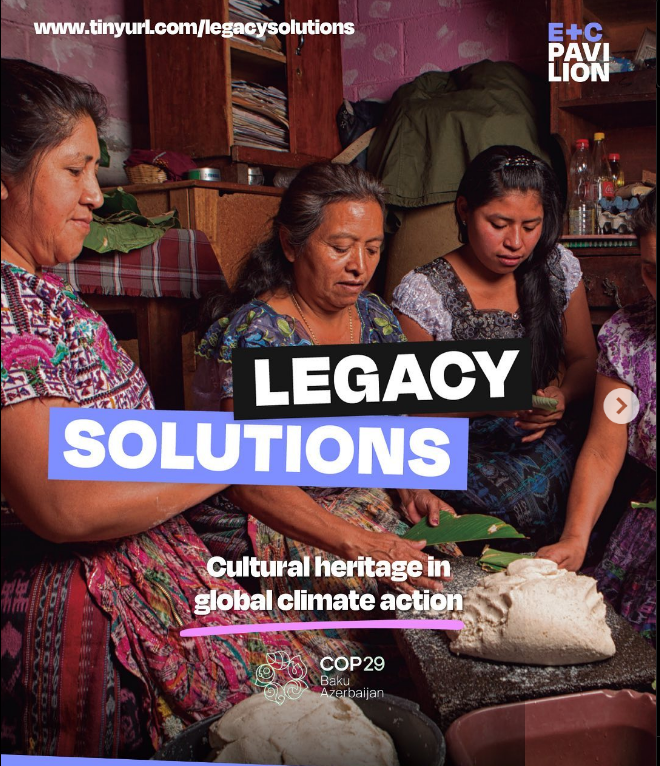

At COP29 in Baku, cultural heritage is taking a leading role in addressing the climate crisis. This year builds on significant milestones from previous conferences. COP27 saw cultural heritage included in the Global Goal on Adaptation (GGA), while COP28 introduced the Emirates Declaration on Culture-Based Climate Action.
Now, at COP29, the launch of the Legacy Solutions: Cultural Heritage in Global Action report highlights how traditional knowledge and cultural practices can drive meaningful climate solutions. According to Samuel Rubin Entertainment and Culture Pavilion, cultural heritage holds legacy knowledge, which is an untapped asset in developing both adaptation pathways and mitigation pathways in response to the climate crisis.
Rubin emphasizes that storytelling, arts, and entertainment can bridge the global and digital divide of understanding how these traditional legacies are already creating the solutions we need for the future in a climate-changed world.
Kenya’s sacred Mijikenda Kaya Forests stand out as a shining example of how culture and conservation intersect. These forests, protected as UNESCO World Heritage Sites, have been preserved for generations by the Mijikenda people through systems rooted in ancestral governance. Overseen by a Council of Elders, the Kaya Forests provide essential benefits such as biodiversity protection, flood control, and climate regulation.
Eric Terena, journalist and founding member of Mídia Indígena pointed out that the spirit, integrity, and traditional uses of cultural landscapes are subject to subtle incremental alterations caused by local impacts of climate change.
“As Indigenous storytellers and journalists, we are on the frontlines of documenting these changes and communicating them to the world. The ‘Legacy Solutions’ reports show how the global community works with cultural legacies and knowledge from our ancestors to preserve our communities while reaching into a rich storehouse of strategies to respond to the unprecedented impacts of the climate crises,” said Eric.
In Kilifi County, the Rabai sub-tribe has taken proactive steps to combat food insecurity and drought by reviving traditional farming methods. By combining ancestral practices with support from institutions like the Kenya Forestry Research Institute (KEFRI), they’ve not only restored agricultural productivity but also improved resilience against climate change. Biocultural tourism initiatives now contribute to local incomes while celebrating the forests’ cultural and ecological value.
The Legacy Solutions report underscores that these practices aren’t unique to Kenya. Around the world, cultural heritage is proving to be a vital tool in the fight against climate change. Indigenous fire management in the Amazon, community-based mangrove restoration in the Sundarbans, and other examples demonstrate the universal potential of traditional knowledge. These practices not only address environmental issues but also promote equity by amplifying voices from marginalized communities.
What’s becoming clear at COP29 is that solutions rooted in cultural heritage aren’t just supplementary—they are central to creating inclusive and effective climate strategies. The report emphasizes that such approaches can connect the dots between science, policy, and local realities, offering a pathway for sustainable development that respects cultural identity.
The Legacy Solutions report makes a strong case for increasing investments in heritage-based climate solutions. This means not only funding but also integrating traditional knowledge into global policies. For policymakers, this is a chance to embrace strategies that balance the preservation of cultural traditions with urgent climate needs.
Luzbeidy Monterrosa, Film Director, Wayuu, Colombia stressed that as filmmakers, creatives, and storytellers, we bring these legacies of heritage to life so that we can understand how they fit into our future.
Kenya’s example through the Mijikenda Kaya Forests offers a model for other nations on how culture intertwines with resilience in response to climate impacts. It shows how blending local traditions with modern approaches can achieve dual goals: protecting the environment and supporting community livelihoods. As the country continues to face challenges like deforestation and prolonged droughts, these lessons are more critical than ever.
As the conference continues, leaders are being urged to recognize the role cultural heritage plays in the broader climate agenda. Addressing the climate crisis requires innovation, but it also requires looking back—drawing on time-tested practices to guide forward-thinking solutions.
The Kaya Forests remind us that heritage is more than history. It’s a living resource that can inspire resilience and hope in the face of environmental challenges. By integrating cultural practices into climate action, COP29 has the potential to set a transformative example for the world.
“As the “Legacy Solutions’ report shows we need to continue to develop global climate policy that ensures that cultural heritage is protected by adaptation strategies, guided by traditional knowledge, Indigenous Peoples’ knowledge, and local knowledge systems. Incorporating a broader range of worldviews, values, and understandings of the relationship between people and nature into decision-making leads to more balanced and sustainable environmental and social outcomes,” said Luzbeidy.